

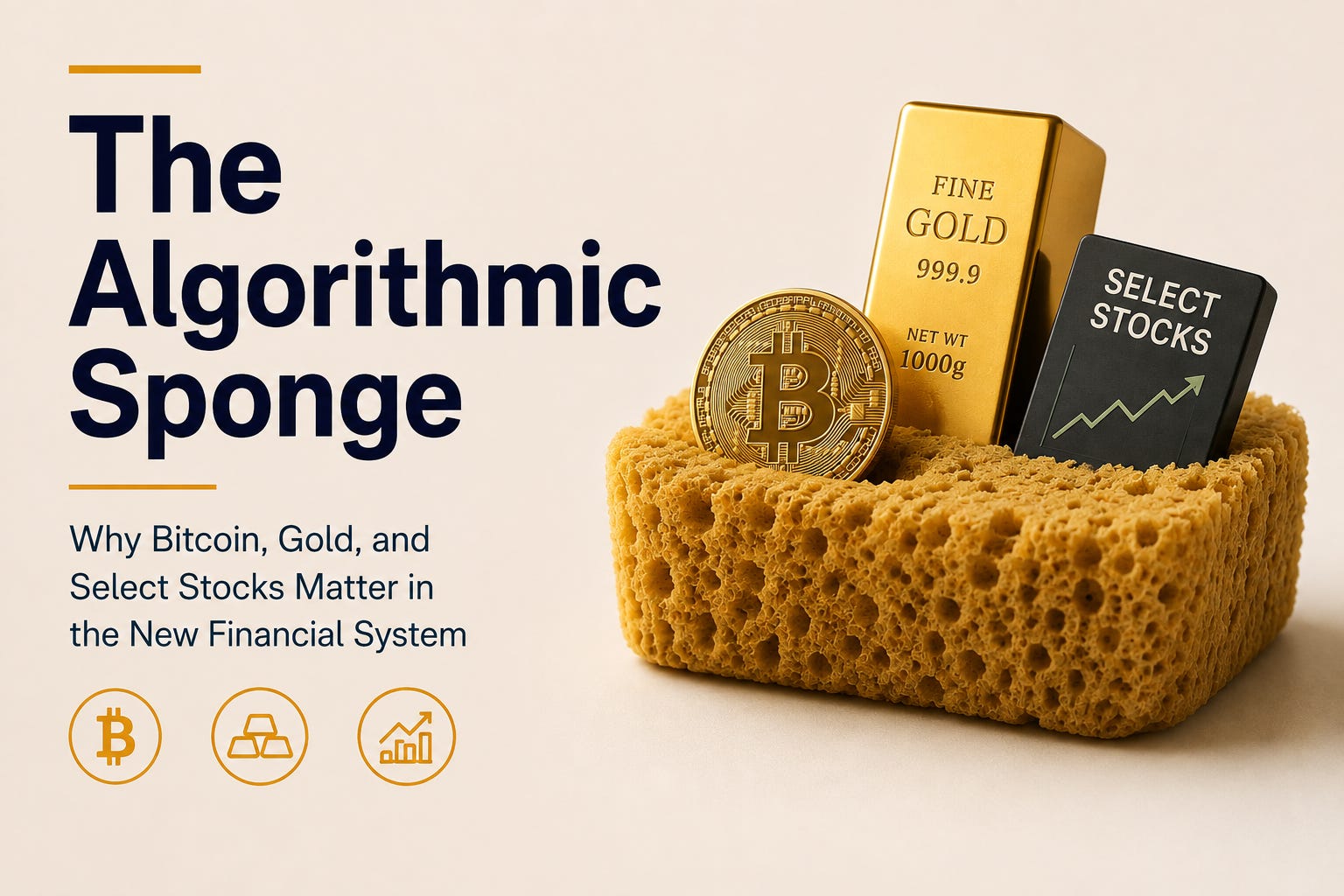
Why Bitcoin, Gold, and Select Stocks Matter in the New Financial System
For decades, investors were taught a relatively simple set of principles:
Buy productive assets. Diversify. Manage risk. Avoid panic. Stay invested.
Those principles remain relevant.
But the financial system surrounding those principles has changed dramatically.
Markets are no longer simply collections of individual human investors making independent decisions. Increasingly, capital moves through index funds, ETFs, retirement accounts, quantitative strategies, automated trading systems, algorithmic execution engines, market makers, and machine-readable information.
Millions of individual financial decisions are being transformed into automated flows.
A worker contributes to a 401(k). A retirement plan allocates the contribution. A target-date fund purchases ETFs. An ETF purchases securities according to an index methodology. A quantitative strategy evaluates volatility. An algorithm executes an order. A market maker continuously adjusts prices.
The human being may have initiated the process.
But the capital can travel through a machine.
This creates a fundamentally different market structure.
One useful way to understand it is to think of the modern financial system as an algorithmic sponge.
A sponge absorbs pressure.
Financial markets do something similar.
Passive investment flows absorb supply. Information systems distribute information rapidly. Algorithms provide liquidity. Quantitative strategies continuously evaluate risk. Market makers adjust prices. Retirement contributions provide recurring capital.
Most of the time, these layers can absorb enormous amounts of financial pressure.
But a sponge has a limit.
When enough pressure accumulates, it becomes saturated.
And when the financial system becomes saturated, the mechanisms that normally absorb volatility can begin transmitting it.
Passive inflows can become outflows.
Liquidity providers can become liquidity takers.
Risk models can reduce exposure.
Leveraged positions can be liquidated.
Algorithms can accelerate movements rather than dampen them.
The result is a financial system that can appear remarkably stable for long periods and then move with extraordinary speed.
This is the central idea behind the Algorithmic Sponge Hypothesis:
Modern financial markets increasingly absorb volatility through layers of mechanical capital, information, and algorithmic execution—until those layers reach their limits.
That idea leads to a larger question.
If the financial system is becoming increasingly interconnected and automated, what kinds of assets should investors own?
The answer does not have to be one asset.
It may instead be a combination of assets that perform fundamentally different jobs.
Productive capital.
Digital scarcity.
Physical scarcity.
That is the case for select stocks, Bitcoin, and gold.
1. The Financial System Has Become a Machine
Traditional investing was built around human judgment.
An investor researched a company.
They examined its financial statements.
They considered management, competition, valuation, debt, growth, and profitability.
Then they bought or sold.
Today, that process still exists.
But it exists alongside a much larger automated system.
Consider a normal retirement contribution.
A person receives a paycheck.
A portion is automatically transferred into a retirement account.
The retirement account allocates capital to a target-date fund.
The target-date fund allocates capital to ETFs.
The ETF allocates capital according to an index.
The index determines which securities receive capital.
The order is executed electronically.
No one necessarily makes a fresh fundamental judgment about every company involved.
The system follows rules.
Multiply that process across millions of workers, thousands of funds, and trillions of dollars of capital.
The result is something much larger than individual investment decisions.
It is a capital allocation machine.
The same is true on the trading side.
Algorithms monitor:
Price
Volatility
Liquidity
Correlation
Momentum
Options markets
Interest rates
Position sizes
Risk limits
Market depth
Economic data
News
Order flow
Computers can evaluate these variables continuously.
They can react in milliseconds.
They can execute trades without fear, fatigue, or hesitation.
This creates tremendous efficiency.
But it also creates something investors need to understand:
Automation doesn’t eliminate risk. It changes the way risk moves through the system.
2. The Three Layers of the Algorithmic Sponge
The modern market can be understood as a three-layer structure.
Layer One: Passive Capital
The first layer is recurring capital.
401(k) contributions.
IRA contributions.
Target-date funds.
Index funds.
ETFs.
Automatic investment plans.
These systems create persistent demand.
An individual investor may not care whether the market is up or down on a particular Tuesday.
Their paycheck still arrives.
Their contribution still occurs.
The fund still allocates capital.
That creates a structural flow of money into financial markets.
The individual decision becomes an automated transaction.
This is powerful because it creates a continuous source of demand.
But it also creates an important vulnerability.
If the flow reverses, the same infrastructure can transmit selling pressure.
3. Information Is Now Instant
The second layer is information.
Historically, information moved slowly.
Investors waited for newspapers.
Then television.
Then financial websites.
Today, information can travel around the world almost instantly.
An earnings announcement can reach millions of investors simultaneously.
A regulatory filing can be analyzed by software almost immediately.
Economic data can trigger automated trading.
Social-media sentiment can be processed by machines.
Price movements are visible in real time.
Options positioning can be monitored continuously.
The internet has dramatically reduced the time between information and action.
This has two consequences.
First, uncertainty can sometimes be reduced because more information is available.
Second, reactions can happen much faster.
Fear spreads faster.
Opportunity spreads faster.
Buying happens faster.
Selling happens faster.
The financial system has become a high-speed feedback loop.
4. Machines Don’t Feel Fear
The third layer is algorithmic capital.
Humans experience emotion.
Machines execute rules.
A human investor might watch an asset fall 20% and think:
“Something is terribly wrong.”
An algorithm might see:
volatility increasing,
correlation rising,
liquidity declining,
a risk threshold being breached,
and automatically reduce exposure.
Neither response is inherently correct.
They are simply different.
Algorithms can create enormous amounts of liquidity and efficiency during normal market conditions.
They can also create enormous amounts of selling when their rules require it.
This is one of the most important characteristics of an automated market.
The machine does not know that everyone else is scared.
It knows that its parameters have changed.
That distinction matters.
5. The Sponge Works—Until It Doesn’t
Imagine squeezing a sponge.
At first, it absorbs water.
Keep squeezing.
Eventually, it becomes saturated.
Financial liquidity can behave similarly.
Under normal conditions:
Capital enters → markets absorb supply → prices adjust → liquidity remains available.
But extreme conditions can change the equation.
A major shock occurs.
Volatility rises.
Investors become defensive.
Redemptions increase.
Leveraged investors face margin calls.
Risk models reduce positions.
Systematic funds sell.
Liquidity providers step away.
Prices fall further.
The decline triggers additional risk controls.
Selling accelerates.
The sponge becomes saturated.
This creates a critical distinction:
Liquidity that exists during normal conditions is not necessarily liquidity that will exist during a crisis.
A market can appear incredibly liquid right up until everyone tries to move through the same exit.
6. Stability Can Create Its Own Risk
One of the most interesting implications of the hypothesis is that stability can encourage risk-taking.
Suppose volatility remains low for years.
Investors become comfortable.
Risk appears manageable.
Leverage increases.
Position sizes increase.
Financial products become more complex.
More capital enters the same strategies.
The system appears increasingly efficient.
Then a shock arrives.
The problem is no longer just the original shock.
The problem becomes the feedback loop.
Volatility increases.
Risk models react.
Positions are reduced.
Liquidity disappears.
Prices fall.
The falling prices create more volatility.
More positions are reduced.
The cycle reinforces itself.
The system has transitioned from absorption to acceleration.
7. The Flash Crash and the Lesson of Automation
The 2010 Flash Crash offers an important historical warning about automated market structure.
The significance isn’t simply that an algorithmic event occurred.
The deeper lesson is that automated systems operate according to rules.
Under normal conditions, those rules can make markets faster and more efficient.
Under abnormal conditions, the same rules can produce unexpected interactions.
This is not an argument against technology.
Technology has transformed finance in enormously beneficial ways.
The lesson is simply:
Investors should understand the system surrounding their assets.
The question isn’t merely:
“What do I own?”
It is also:
“How does the market for what I own function?”
8. Stocks: Ownership of the Productive Economy
Stocks sit directly inside this financial machine.
That is not necessarily a weakness.
It is one of their greatest strengths.
Stocks provide ownership in businesses.
Businesses create products.
Businesses provide services.
Businesses employ people.
Businesses generate cash flow.
Businesses innovate.
Businesses build infrastructure.
Businesses compound capital.
Over long periods, productive businesses can create enormous economic value.
This is why equities remain one of the foundational building blocks of long-term wealth.
But there is an important distinction:
Owning stocks is different from trading stocks.
A long-term owner doesn’t necessarily need to predict every short-term movement.
The investor owns the underlying business.
The market provides a continuously changing price.
Those are two different things.
A stock can fall while the business becomes stronger.
A stock can rise while the underlying economics deteriorate.
Short-term markets are often driven by liquidity, positioning, sentiment, options, passive flows, and algorithms.
Long-term business value is driven by economics.
That distinction creates an opportunity for long-term investors.
9. Why Select Stocks?
The argument for equities does not necessarily mean owning every stock indiscriminately.
A company is not automatically a good investment simply because it is publicly traded.
Businesses have different economics.
Some generate substantial free cash flow.
Some possess durable competitive advantages.
Some have strong balance sheets.
Some benefit from long-term technological shifts.
Some have pricing power.
Some require enormous amounts of capital.
Some carry significant debt.
Some depend on favorable financial conditions.
Some face structural decline.
The objective is therefore not simply to own “stocks.”
It is to own productive businesses with durable economics.
That is the role of select stocks in this framework.
The investor is looking for companies capable of producing value independent of short-term market enthusiasm.
This doesn’t eliminate risk.
But it changes the source of the investment thesis.
The thesis becomes:
I own part of a productive economic enterprise.
10. Bitcoin: A Different Kind of Asset
Bitcoin introduces an entirely different concept.
A stock represents ownership in a company.
Bitcoin does not.
Bitcoin is a scarce digital monetary asset operating on a decentralized network.
It does not have a CEO.
It does not have a board of directors.
It does not issue shares according to management discretion.
Its monetary rules are embedded in its protocol.
This gives Bitcoin an unusual position in the financial system.
Bitcoin is increasingly connected to traditional markets.
It can be accessed through institutional investment products.
It can be traded through traditional financial infrastructure.
It can exist inside portfolios alongside stocks and bonds.
But the underlying Bitcoin network remains fundamentally distinct from a corporation.
That creates an unusual combination:
Bitcoin is increasingly integrated into the financial system while maintaining a monetary network that does not depend on a single company or government.
11. Bitcoin as Digital Scarcity
The key concept behind Bitcoin is scarcity.
The digital world traditionally made copying easy.
Information can be copied.
Files can be duplicated.
Digital goods can be reproduced.
Bitcoin introduced a mechanism for establishing scarcity within a digital monetary network.
That scarcity is enforced by a decentralized protocol.
This gives Bitcoin a fundamentally different investment thesis from stocks.
An investor buying a stock is primarily purchasing productive capacity.
An investor buying Bitcoin is purchasing exposure to:
Digital scarcity
Monetary network effects
Decentralized infrastructure
Global liquidity
A predetermined issuance framework
An asset capable of being held directly
Bitcoin is not a substitute for a productive company.
It is a different category of asset.
That difference is precisely why it can complement stocks.
12. Bitcoin and the Algorithmic Financial System
There is an interesting paradox.
Bitcoin was created outside the traditional financial system.
Yet Bitcoin is increasingly being incorporated into it.
Institutional products can bring Bitcoin into traditional portfolios.
Algorithms can trade Bitcoin.
Quantitative funds can model Bitcoin.
Market makers can provide liquidity.
Institutional investors can gain exposure through conventional financial infrastructure.
Bitcoin therefore becomes both:
Inside the financial machine and outside it.
This distinction matters.
Bitcoin can be traded through centralized intermediaries.
But it can also be held directly.
An individual can hold the underlying asset without requiring a traditional financial institution to maintain the economic claim.
That creates another form of diversification.
Not simply diversification between assets.
But diversification between systems of ownership.
13. Gold: The Physical Monetary Layer
Gold provides yet another form of scarcity.
Bitcoin is digital scarcity.
Gold is physical scarcity.
Gold has existed as a monetary asset for thousands of years.
It has no CEO.
It has no quarterly earnings report.
It does not require revenue growth.
It is not dependent on corporate management.
Physical gold exists independently of a company’s balance sheet.
That characteristic becomes particularly interesting when thinking about systemic risk.
If an algorithm stops providing liquidity, a physical gold coin doesn’t receive a margin call.
If a quantitative fund liquidates a position, the physical gold itself does not have to sell.
If an index fund experiences redemptions, a physical gold bar does not have to rebalance.
Gold can certainly fall in price.
It can remain flat for extended periods.
It can underperform productive businesses.
There is no guarantee that gold will appreciate in every environment.
But physical gold has a unique property:
It exists outside the corporate and algorithmic financial system.
That is the point.
14. Physical Assets and System Independence
This leads to a broader principle.
Financial diversification is often measured by the number of securities in a portfolio.
But there is another way to think about diversification.
System diversification.
Consider an investor who owns 30 technology companies.
On paper, that investor owns 30 securities.
But those companies might share exposure to:
Interest rates
Equity liquidity
Consumer demand
Institutional risk appetite
Technology spending
Capital markets
Passive investment flows
Thirty securities do not necessarily equal thirty independent risks.
The same principle applies to financial intermediaries.
Owning an asset through five platforms does not necessarily mean owning five fundamentally different forms of exposure.
True diversification asks:
What does this asset depend on?
Who controls it?
How is supply determined?
How is ownership established?
How does price discovery occur?
What happens when liquidity disappears?
What happens when financial intermediaries experience stress?
These questions lead to a deeper form of portfolio construction.
15. Three Forms of Scarcity and Production
This is where the three-part framework becomes powerful.
Select Stocks
Productive capital.
Stocks represent ownership in businesses.
Their long-term value can come from:
Earnings
Free cash flow
Innovation
Productivity
Economic growth
Capital allocation
Bitcoin
Digital scarcity.
Bitcoin provides exposure to:
A decentralized monetary network
Digital scarcity
Network effects
Global liquidity
A distinct monetary architecture
Gold
Physical scarcity.
Gold provides exposure to:
Physical scarcity
Monetary history
Durability
Non-sovereign value
A tangible asset outside corporate balance sheets
Three assets.
Three different concepts.
Three different dependencies.
16. Why This Combination Matters
The argument is not that Bitcoin will always outperform stocks.
It is not that gold will always outperform Bitcoin.
It is not that stocks will always outperform gold.
Those are predictions.
The more useful question is:
What role does each asset play?
Stocks provide productive economic exposure.
Bitcoin provides digital monetary exposure.
Gold provides physical monetary exposure.
This creates a portfolio where the underlying investment theses are not identical.
The assets can respond differently to:
Economic growth
Inflation
Interest rates
Monetary policy
Liquidity
Financial stress
Technological change
Investor sentiment
That does not make the portfolio immune to losses.
It makes the sources of risk more diverse.
17. The Portfolio as a Resilience System
A portfolio can be viewed as more than a collection of investments.
It can be viewed as a resilience system.
Stocks provide productive economic exposure.
Bitcoin provides digital monetary exposure.
Gold provides physical monetary exposure.
Cash provides liquidity.
Each component can serve a different purpose.
The objective is not to maximize every asset simultaneously.
The objective is to construct something that can survive different environments.
During economic expansion, productive businesses may benefit.
During monetary uncertainty, scarce monetary assets may become more important.
During severe financial stress, physical and directly held assets can provide forms of diversification from traditional financial plumbing.
This is not about predicting the future.
It is about preparing for multiple futures.
18. The Most Important Question
The Algorithmic Sponge Hypothesis ultimately leads to a simple question:
What happens when the systems designed to absorb risk become the systems transmitting risk?
Consider the sequence.
Markets rise.
Passive investment increases.
Volatility declines.
Investors become comfortable with risk.
Leverage increases.
A macroeconomic shock occurs.
Volatility rises.
Risk models react.
Systematic strategies reduce exposure.
Liquidity disappears.
Selling accelerates.
The initial event may not be the biggest problem.
The feedback loop can be.
That is why investors should not assume that today’s liquidity conditions will necessarily exist tomorrow.
The financial sponge can absorb enormous pressure.
But it cannot absorb unlimited pressure.
19. The New Definition of Diversification
Traditional diversification asks:
How many assets do I own?
A deeper question is:
How many different sources of value do I own?
That distinction is enormous.
An investor can own dozens of stocks while remaining highly exposed to the same economic system.
Another investor can own fewer assets but diversify across fundamentally different forms of value.
Productive companies.
Digital monetary assets.
Physical monetary assets.
Liquidity.
These are different sources of exposure.
The goal is not to eliminate uncertainty.
That is impossible.
The goal is to avoid making the entire financial future dependent on one mechanism working perfectly.
20. The Future Will Probably Be More Automated
The trend toward financial automation is unlikely to reverse.
More assets will become digitized.
More investing will become automated.
More information will become machine-readable.
More trading will be executed algorithmically.
Artificial intelligence will increasingly participate in research, portfolio construction, execution, and market analysis.
Financial markets will become faster.
They may also become more efficient.
But faster systems can create faster feedback loops.
A human investor might take hours to react.
A machine can react in milliseconds.
That can create extraordinary liquidity during normal conditions.
It can also create extraordinary speed during periods of disorder.
This makes understanding financial infrastructure increasingly important.
The question isn’t only:
“What asset should I own?”
It is:
“What happens to my asset when the financial system changes behavior?”
21. The Case for Bitcoin, Gold, and Select Stocks
The strongest argument for this combination is not that these assets are guaranteed winners.
Nothing is guaranteed.
The argument is structural.
Select stocks represent productive capital.
They provide exposure to companies that create products, services, cash flow, innovation, and economic value.
Bitcoin represents digital scarcity.
It provides exposure to a decentralized monetary network with a distinct issuance structure and the ability to exist independently of any single corporation.
Gold represents physical scarcity.
It provides exposure to a tangible monetary asset that has no corporate balance sheet, no earnings report, and no requirement for continuous algorithmic liquidity.
Together, they provide three fundamentally different forms of ownership.
22. The Deeper Investment Thesis
The future financial system may become increasingly digital, automated, interconnected, and algorithmic.
That development brings enormous advantages.
Transactions become faster.
Information becomes more accessible.
Markets become more efficient.
Capital can move globally.
But increasing automation also means investors should understand systemic dependencies.
When the system works, automation can be extraordinary.
When the system becomes stressed, automation can transmit stress extraordinarily quickly.
This creates a reason to think beyond traditional diversification.
Don’t only diversify across companies.
Diversify across types of value.
Don’t only diversify across securities.
Diversify across systems.
Don’t only ask what might appreciate.
Ask what you actually own.
Conclusion
Why Bitcoin, Gold, and Select Stocks
The case for Bitcoin, gold, and select stocks begins with a simple observation:
The financial system is changing.
Capital is becoming increasingly automated.
Passive investing creates mechanical flows.
Information travels instantly.
Algorithms continuously evaluate markets.
Quantitative strategies manage enormous pools of capital.
Artificial intelligence is becoming increasingly involved in financial analysis and decision-making.
The result is a financial system capable of absorbing enormous amounts of volatility.
But absorption is not the same thing as elimination.
The algorithmic sponge can become saturated.
When it does, liquidity can disappear, risk models can react simultaneously, leverage can unwind, and market movements can accelerate.
This is why portfolio construction should be about more than predicting what will go up.
It should be about understanding what you own and what that asset depends upon.
Select stocks provide ownership in productive businesses.
They represent the economic engine of human productivity, innovation, earnings, and growth.
Bitcoin provides digital scarcity.
It represents a fundamentally different monetary architecture—one increasingly connected to traditional financial markets while maintaining a decentralized underlying network.
Gold provides physical scarcity.
It is a tangible monetary asset that exists independently of corporate earnings and does not require continuous algorithmic liquidity simply to physically exist.
Three assets.
Three different forms of value.
Productive capital.
Digital scarcity.
Physical scarcity.
That is the deeper reason to consider all three.
Not because one is guaranteed to outperform the others.
Not because any asset is risk-free.
And not because the future can be predicted with certainty.
Rather, because the future is uncertain.
A resilient investor doesn’t need to know exactly what the next crisis will look like.
They need to own assets capable of serving different purposes when conditions change.
When the economy grows, productive businesses can participate.
When monetary conditions change, scarce monetary assets can provide a different source of exposure.
When financial infrastructure becomes stressed, directly held and physical assets can provide another layer of independence.
The objective is therefore not to build a portfolio that wins every year.
It is to build a portfolio that can remain relevant across different environments.
The most important question isn’t:
“What will go up?”
It is:
“What do I own when the system works—and what do I own when the system doesn’t?”
That is the core lesson of the Algorithmic Sponge.
Own productive businesses.
Own digital scarcity.
Own physical scarcity.
Own select stocks.
Own Bitcoin.
Own gold.
Not because they are the same.
But precisely because they are not.